Sunday, July 29, 2012

On Fasting, Remembrance and the Future

Siddur Avodat HaShem - Tisha b'AvI just broke my fast.

Yes, it's only four p.m. in Winnipeg. The sun is still shining brightly. My Orthodox brothers and sisters are all still fasting, and will continue to do so until nearly 10 p.m. I am quite stringent in my observance of the Yom Kippur fast, so why have I broken this one, the fast of Tish'a b'Av, early?

This morning I went to shul and heard the book of Eicha, or Lamentations, read. I sat on the floor with my fellow Jews at the foot of the Holocaust memorial in our chapel and listened to the horrors of the siege and destruction of Jerusalem, over 2000 years ago. The Torah reading and Haftarah (Prophetic portion) are just as depressing and frightening. In my mind's eye, those same scenes of death and grief were transposed to stories and pictures from the Holocaust, to the horrible tales of pogroms we retell during the Yom Kippur service, to all the places and times that Jews have been persecuted. 

All that grief, fear and horror have been channelled by Jewish tradition into this one day, right in the middle of the summer. It was not only the date of the destruction of both Temples, it was also the date of the expulsion of the Jews from England in 1290, and from Spain in 1492. It was even the date that the first trains from the Warsaw Ghetto reached Treblinka with their doomed passengers.

In memory of all these terrible things, the first part of Tish'a b'Av is a time of mourning. We not only fast, but we follow many of the traditions of a house of mourning - we don't greet each other, we sit on the floor with our shoes off. We read Eicha and various other poems of lamentation. We do this in the evening, and again in the morning. For the morning service, we do not wear our tallit and tefillin as we normally do. We omit all joyful parts of the service. All is mourning and tears. The weight of the past is heavy on our shoulders.

In the afternoon, though,  the mood changes. As we come together for mincha, the afternoon service, we catch up on the joyful parts of the morning service we left out. We even wear our tallit and tefillin in the afternoon, which is otherwise unheard of (the only exception is that we wear our tallit to the Kol Nidrei evening service on Yom Kippur - but that's a whole different kettle of fish). We remember the old Talmudic prophecy that the Messiah would be born on Tish'a b'Av. Out of  the ashes, there is hope. For many Jews, the existence of the State of Israel indicates the beginning of the Redemption.

So why do we continue to fast in the afternoon? Just because we always have? Some Conservative rabbis have wrestled with this problem. If we feel that the Redemption has begun, that the hope of the renewal of the Jewish people is taking concrete form, why do we continue to act in the same way as we did when the world was in darkness? Also, many people still fervently desire the rebuilding of the Temple and resumption of animal sacrifices. Others of us, however, would prefer to keep on the spiritual plane of  "I desire lovingkindness and not sacrifice" (Hosea 6:6) that the Rabbis have led us to since the destruction of the physical buildings. The great rabbi Maimonides even suggested that the animal sacrifices were a concession to the primitive nature of the Jews of the time, and that true apprehension of G-d could only be achieved through the intellect - he felt that even prayer was a concession to our childish need for a personal relationship. You can imagine how popular that particular stance made him with his fellow clergy - in fact, his works were banned and even burned, despite his being considered one of our greatest scholars.

I cannot pretend to follow or reproduce all the halachic arguments about the partial fast, which are reproduced here. I am not a rabbi, nor do I play one on any type of social media. But I do know that at least two rabbis whom I respect very much follow this ruling, and declare that after the resumption of normality at mincha on the afternoon of Tish'a b'Av, the fast can be broken. It's not a game of "I can fast longer than you" - it's a declaration that we do believe that the Redemption has begun, that the continuation of the fast into the afternoon is not necessary - one could argue, even inappropriate.

What say you?

Wednesday, July 25, 2012

Durian and Hearsay

DurianI know a guy here in Winnipeg who likes to tweet about food (among other things). I've been trying to get him to join the Manitoba Food Bloggers, but he says he's not that social. He does send out the most mouth-watering tweets ... maybe one day we'll get him to post recipes and stuff.

Anyway, he posted the other day about durian. I confess that I reacted with the utmost disgust. My friend immediately called me out by asking me if I'd ever tried it.

OK, I admit it. I've never tasted durian. More to the point, I've never smelled it. Apparently that is the salient point about durian - the authentic odour. You either love it or hate it, so I'm told.

The point is that I appear to have an opinion on durian, completely second-hand, based entirely on hearsay. I don't actually know whether I think durian smells disgusting, because I've never smelt it. My friend says it is quite good when ripe, and doesn't necessarily smell bad. He's speaking from experience. I have promised to give it a try one of these days and report back.

Of course this little, trivial conversation had me thinking about hearsay and the conclusions we all draw without adequate information. Some might call it malicious gossip, when we feel negatively about something, or more importantly somebody, based on other people's experiences. Now, I'm not concerned that I hurt the durian's feelings, and I'm sure Kim Kardashian doesn't give two hoots what I think about her, even though I don't know anything about her first-hand (and am quite happy to keep the relationship at this distance).

But now I'm thinking about real people in my life, or even real people in my city or in my online communities, upon whose lives I might actually impinge one way or another. It suddenly becomes much more imperative that I not form opinions without adequate information. If somebody tells me something bad about someone we both know, surely it is incumbent upon me, if I intend to do anything with this information, to gather evidence on the matter rather than spread gossip. It seems obvious, but I can't help wondering how many of us actually take the trouble to verify those delicious little tidbits of gossip. Defamation can happen very quickly. It doesn't matter if it's a fruit, but it definitely matters to a person.

In Judaism, even if the gossip is true we are prohibited from spreading it unless there's an extremely good reason for doing so. This concept is called Lashon HaRa, the evil tongue. It differs from defamation in that the gossip is true - but so what? Unless somebody's life or well-being depend on this knowledge being spread, we are supposed to just shut up.

As we begin to approach the High Holy Days, with their call for soul searching and self-improvement, Lashon HaRa is often at the top of people's lists. I would love to have an ongoing conversation about this. When should discreditable knowledge be spread, and when not?

Oh, and I still have to go pick up some durian from the Asian market. Stay tuned.

Sunday, July 22, 2012

I'm a Shabbat Guest!

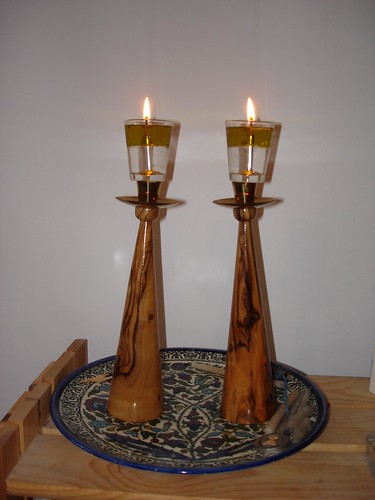
Shabbat lights
My new friend Miriam Steinberg-Egeth has got one of the coolest Jewish blogs you are going to see anywhere. Last year she blogged each of her Shabbat experiences for the entire year. This year, she's getting her friends to do it for her, clever girl.

Getting 52 friends to blog for you can be a bit of a stretch, so Miriam put out an invitation to a group of Jewish women bloggers. I'm very fortunate to be a member of this group - there are some pretty darned big names here, and I'm humbly learning from them and everyone else.

I'm especially fortunate that Miriam agreed to have me be one of her guest bloggers! Woo hoo!

So, here it is - me posting on Miriam's blog about a summer Shabbat in Winnipeg - this past one, to be exact. I love her reference to alternate spelling - she clearly needs more Canucks on this blog! If you have something to say about Shabbat, consider contacting Miriam. Even if you don't, her blog is a pleasure for anyone to read.

You can put your comments here or on Miriam's blog - we both love them!


Thursday, July 19, 2012

This Kosher Paleo Steer Has Sharp Horns

Grazing cows in Sudbury Meadows

Torn between two lovers, feeling like a fool ... loving both of you is breaking all the rules ... remember that song? It's how I feel when I think about keeping kosher, and keeping paleo. Mary McGregor sang about a woman who loves two men at the same time, for the different things they bring to her life. That's how I feel about paleo and kashrut, and living in Winnipeg, they really are not compatible. The horns of this dilemma are getting sharper and sharper as I struggle to bring my health back under control after the stress of Ari's Bar Mitzvah.

I have had an auto-immune disorder since 1987 (at least). At times of great stress and/or lack of sleep (they do tend to come together, don't they?), it will flare up without fail. In the past I have had to resort to steroids and other unpleasant medication. I became a vegetarian in 1992, after a particularly virulent flareup that landed me in hospital for six weeks. I knew something was wrong with my diet, but I didn't know what.

In the last few years I have come to the conclusion that the high-carbohydrate diet we were all encouraged to ingest in the 90s (and which I have inculcated all too well into my children, sigh) is part of my problem. To reduce the amount of carbohydrates in my diet and increase the protein and fat, I have begun eating wild-caught salmon and local pickerel and pike. I have blogged about all this before.

I have not, however, brought meat and fowl back into my life, and this is where the horns of my dilemma are.

It is not hard to find kosher meat in Winnipeg. It would be very disruptive to my home to start buying and cooking it, because right now my kitchen is completely dairy. Fish is considered pareve (neither meat nor dairy). Once upon a time the same was true of chicken, but it has been considered meat (despite having neither hooves nor cud) for centuries now, so I am not going there. In any case, I would have to buy a completely new set of dishes, pots, pans and everything, and make room in my small kitchen for everything to be double.

I might have done all of that, but all kosher meat that I have seen in this city comes from factory farms. And that's where I hit the second horn of the dilemma.

It is not hard to find grass-fed, pastured meat in Winnipeg. But it is not kosher. It is halal, but not kosher. I know Jews who have declared it to be Eco-kosher, meaning that they consider its provenance as grass-fed to be more important than its slaughter with a sharp knife, removal of the non-kosher sinew and everything else that is involved in kosher slaughter. I am not at that point - keeping a kosher home is a very important part of the identity of my family. We keep Shabbat and other laws, and we are not prepared to bring non-kosher meat into our home.

But I am also not prepared to eat factory-farmed animals. I don't think that eating them would improve my health in any way, and I don't want to support that industry. While I find that I am not emotionally attached to being a vegetarian, per se, I do not want to take part in the maltreatment of animals. This quite aside from the indisputable fact that factory-farmed animals produce inferior meat, high in Omega-6 and low in Omega-3.

There are companies out there that provide grass-fed, kosher meat. The nearest buying club that I can find is in the Twin Cities. The buying clubs give a certain discount for bulk, and you have to pick it up from a JCC or synagogue, four times a year or more if there is demand. Otherwise you really need to be near NYC.

Bringing this meat to Winnipeg would be a huge undertaking. Am I talking myself into it? Or should I just accept that I am not going to be able to eat a truly paleo diet, to support my body with the nutrients it needs? And what about that desire to support local farmers, rather than bringing in frozen food from far away?

What I really need is for somebody to start slaughtering locally bred, pastured animals in the proper kosher fashion. Even if it is just chickens, to start with. I wonder if that is an even huger undertaking than bringing it in from the United States?

What to do, what to do?

Sunday, July 15, 2012

Thoughts on Mayonnaise, Paleo and Local Eating

So I decided to make mayonnaise today. I grabbed my blender (a cheapo from Superstore - maybe one day I'll have a really good one, but this will have to do for now), and my printout of Sarah Fragoso's paleo mayonnaise recipe, and off I went. I've made it before and loved it (especially with fresh ginger added!).

Turns out, I didn't have plain olive oil in the house (the extra virgin tastes too strong). But I did have a bottle of local, non-GMO canola oil, left over from the Manitoba Food Bloggers' bake sale. So I decided to give it a try.

Wow, that oil is deep yellow in colour. So is the mayonnaise, as you can see. It tastes fine, except that I think I put in a little too much mustard. But it has me thinking about the whole paleo vs. (and does it need to be versus?) local thing.

I love being a locavore, within reason. I do realise that I live in Manitoba, not California or even Virginia. There's been a lot of chatter recently about this new anti-locavore book, claiming that eating locally means going back to subsistence farming, which is horrible, inefficient and bad for the environment. I think that's a straw man argument - I don't know anybody who claims that people should raise inappropriate crops just to be self-sufficient. Except maybe North Korea and, according to the authors, Quebec. Still, anybody who thinks that everything in modern agriculture is just peachy needs to pull their heads out of the sand. The decision after World War II to turn the munitions factories into fertiliser production plants, sparking the "Green Revolution", has turned out to be a mixed blessing, to say the least. The ability to grow insane amounts of soy and corn was supposed to feed the world. Instead it seems to have led to the current obesity epidemic. But that's maybe another blog post, with serious research links. There are a lot of very smart people out there, with arguments on both sides of the question, and it is worth thinking about what they have to say.

The question that is vexing me right now, however, is embodied in two glass bottles. The paleo movement, which I think is doing great things for the health of North Americans, frowns on the use of seed or vegetable oils, because they are highly refined and processed. In the case of canola, it is also highly likely to be genetically modified, with all the potential health issues that follow. If you want to make paleo mayonnaise, the way to go is with olive oil.

However, there is no way in a million years that olives are ever going to grow anywhere near Manitoba, unless global warming reaches a point where we have much greater problems than what oil to use. If I am going to use olive oil, it has to be imported. I do use a lot of coconut oil without any hesitation, because I believe that the medium-chain triglycerides are good for me and my family. But you can't make mayonnaise with coconut oil.

So if I have a bottle of local, non-GMO canola oil, grown and processed on a farm right here in Manitoba, or a bottle of imported olive oil that I bought at Safeway, which is the lesser evil?

I would love to know what you think.

Friday, July 13, 2012

I Love Manitoba Public Insurance!


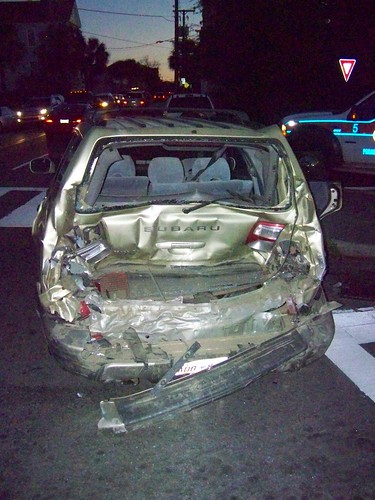
202/365 (December 30, 2008) - Ouch! - The Forrester After the Accident
First of all, thank G-d this is NOT my vehicle. It's a picture I found on Flickr, and the owner had very generously put it in a Creative Commons licence, which means I am free to use it. Important to know if you blog. I've been using my own pictures lately, since I have a lovely camera with an Internet connection in my pocket (also known as an iPhone). But I digress ...

I did, however, get rear-ended yesterday. I was sitting in traffic, minding my own business while waiting for a pedestrian corridor to clear. A maroon van was behind me, also minding its own business.

Next thing we both know, some guy in a green Villager bashes into the back of the maroon van, probably at a full 60 clicks. She bashes into me. Luckily I have a habit of leaving a decent distance between myself and the car in front of me, so I didn't hit anybody. I didn't see it coming so I had my foot on the brake, unfortunately. I doubt my van is actually damaged from that but it did mean my body took a nasty jolt.

I pulled off into a side street and stepped out to view the damage. To my van, luckily, not much - I have a nice imprint of her front license plate (and holes punched by the two bolts) in my back bumper, but it doesn't seem otherwise damaged. To my body, I'll find out. So far just a little stiff in the shoulders and neck, and I've had a few warning spasms from my back, but they've gone away each time.

The driver who hit both of us was out and walking around right after, making no bones about his responsibility. Not that he could have, of course, there were witnesses. The front of his vehicle had crumpled as it should, and a nasty green flood flowed out of his radiator. His airbag had deployed, but he seemed OK, if a bit dazed. The driver in the middle, poor soul, was in shock, of course, and her vehicle was pretty bashed up in the back. The front looked OK to my untrained eye, consistent with the lack of serious damage to my vehicle.

The cops were there pretty quickly, we exchanged information and I went on my way to collect Shira from day camp. The other two vehicles undoubtedly had to be towed.

So why do I love Manitoba Public Insurance? I phoned them today and gave them all the information I had (turned out mine was the first report). We opened a possible injury claim for me. If I do turn out to have whiplash, I just need to go to my family doctor and if she says I need a physiotherapist or a chiropractor, the person can just bill MPI directly. I do need to take the vehicle in to be assessed because it was a three-car accident, even though I have no intention of having any cosmetic repairs done to a ten-year-old vehicle. If  the adjuster says it needs a new bumper or anything else, though, MPI will cover it fully. The person in the call centre gave me a number to call if I have any questions, and was generally thoughtful and empathetic and understanding of the whole trauma. And the best part? I don't have to deal with the other drivers or their insurance - since we are all covered by the same institution, his penalties and our compensation are separate from each other.

Public insurance rocks - because the risk is spread out over so many people and they do not have a mandate to make a profit, not only do they not need to nickel and dime me, but the insurance for the YEAR for my 16 y/o driver is $60, unless he gives them a reason to do otherwise.

Manitoba is a pretty darned good place to live!

Thursday, July 12, 2012

Blogging the Failures

I'm sad right now. I've just had to throw out a large quantity of (formerly) beautiful, very expensive organic almonds, entirely due to my own procrastination and stupidity. In short, I put them to soak for too long, with too little salt water, and in too hot a kitchen, and they got moldy. I hope I can get more - they've been hard to find lately. G-d knows they aren't local around here, but they are an important part of our diet.

So now I am wondering about what the "big kids", the "real" food bloggers do when they have a culinary disaster. I don't remember ever seeing anybody blog about something that went badly wrong and they had to dump it. It's certainly not the most attractive picture I've ever taken, but it is part of the chronicle of my journey to eating real food and supporting my local economy (I did buy them from a small local store, not a big chain). Sometimes things go wrong, sometimes they go magically right, and we hope the latter will outweigh the former as time goes on and we become more skilled.

What do you think, have you ever seen a food blogger post a sad picture of their garbage can?? (Although I'm thinking I can salvage some small fraction of the almonds' value to the universe by transferring them to the compost ...).